Nail Knowledge
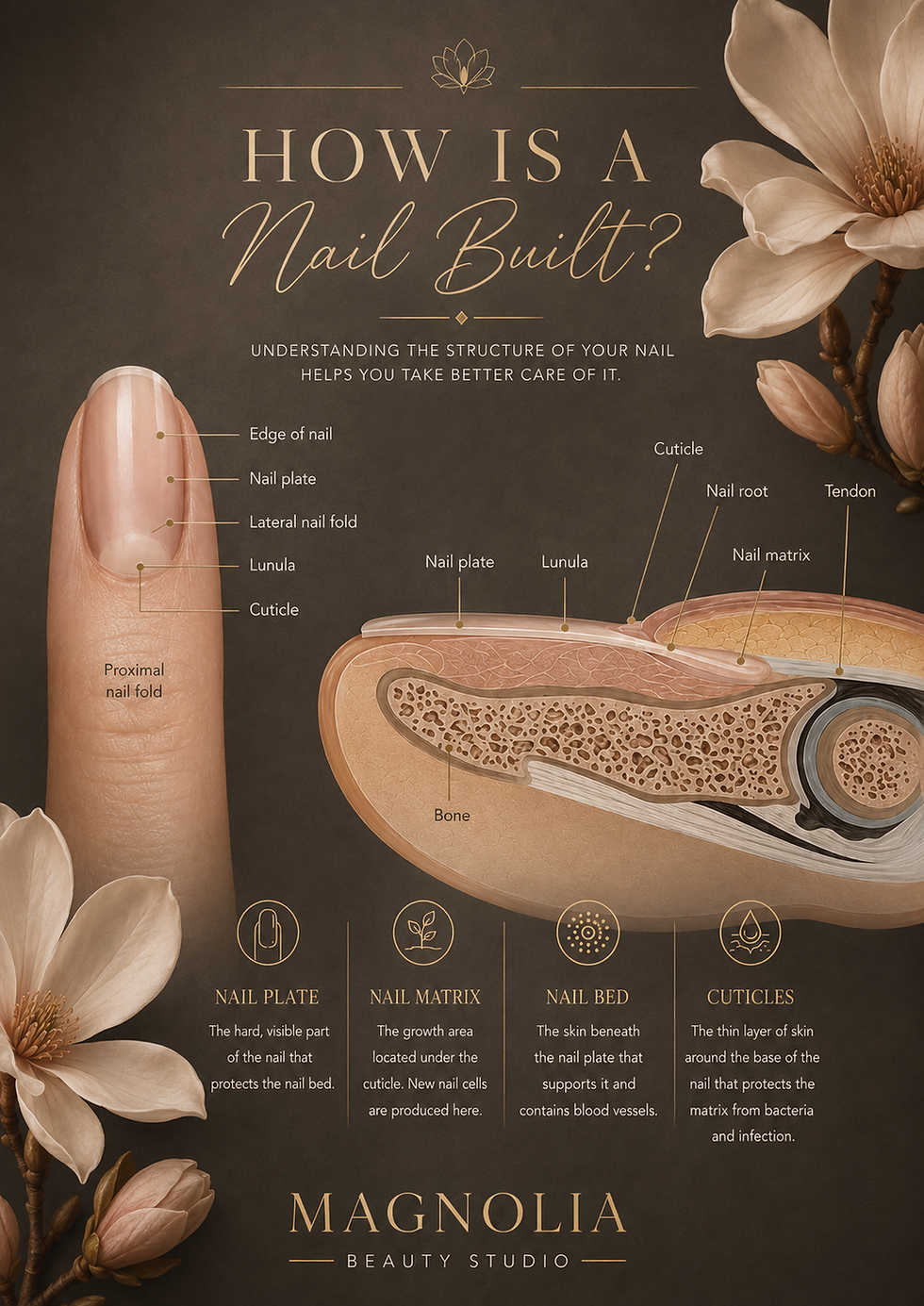
How Is a Nail Built?
Your natural nail is more complex than it may look.
Understanding its basic structure helps explain why some areas are more sensitive, why certain damage can affect nail growth, and why professional nail care should always be gentle and precise.
The nail plate, matrix, nail bed, cuticle and surrounding folds all have different roles. Some parts protect the nail, while others are responsible for growth and support.
Knowing how the nail is built makes it easier to understand why I may sometimes recommend a different treatment, extra care, or time for the nail to recover before applying new product.
Do Nails Need a Break to "Breathe"?
You've probably heard someone say:
"You should take a break from gel or BIAB so your nails can breathe."
In reality...
Nails don't breathe.
The nail plate is made of hardened keratin—the same protein found in your hair.
Unlike your skin, the nail plate doesn't have lungs or pores that absorb oxygen from the air.
Instead, the living part of the nail receives oxygen and nutrients through the bloodstream.
So Why Do Some Nails Feel Weak After Removing Gel?
The gel itself isn't usually the problem.
Most damage happens when products are removed incorrectly.
Peeling, picking or forcefully scraping off gel can remove layers of the natural nail, leaving it thinner, weaker and more sensitive.
This damage is often mistaken for the nails "needing a break," when in fact they need time to recover from improper removal.
Do I Ever Need to Stop Wearing Gel?
Not necessarily.
If your nails are healthy and your products are applied and removed correctly by a professional, there is usually no medical reason to take regular breaks.
Many people wear professional nail enhancements continuously for years without problems.
When Is a Break a Good Idea?
A temporary break may sometimes be recommended if:
-
your nails have been significantly damaged,
-
you have experienced trauma or an injury,
-
there are signs of infection or another nail condition,
-
your nail technician recommends further assessment by a healthcare professional.
In these situations, the goal isn't to let the nails "breathe."
It's to allow the natural nail and surrounding tissues to heal.
Healthy Nails Come from Healthy Habits
Beautiful nails don't depend on taking regular breaks from gel.
They depend on:
-
correct application,
-
professional removal,
-
regular maintenance,
-
good aftercare,
-
and avoiding picking or peeling off products.
Healthy nails don't need to breathe.
They need proper care.

Why Does It Sometimes Burn in the Lamp?
One of the most common questions clients ask during a nail appointment is:
“Why does it burn in the lamp?”
The lamp is not burning your nail. The sudden feeling of heat is caused by the nail product curing.
When a light-cured nail product is placed under a UV or LED lamp, a chemical reaction begins and the product hardens. This reaction releases heat and is known as an exothermic reaction.
For some clients, this warmth is barely noticeable. Others may experience a short, more intense heat spike.
The sensation can vary from person to person, from product to product and even from one appointment to another. Feeling heat does not automatically mean that something has been done incorrectly.
Heat spikes are often more noticeable with builder products, as they are usually applied in a greater amount than colour or top coat. However, warmth can sometimes also be felt when curing a thin layer of base, colour or another light-cured product.
What Should You Do If It Feels Too Hot?
A mild feeling of warmth can happen while nail products are curing.
However, if the heat becomes uncomfortable or painful, tell your nail technician immediately.
There are different ways to make the curing process more comfortable, depending on the product and the stage of the treatment. Your nail technician will know how to respond and help you.
There is no need to suffer in silence.
Always let your nail technician know what you are feeling so they can make the treatment as comfortable as possible.

Are UV/LED Nail Lamps Dangerous?
This is one of the most frequently asked questions—and one surrounded by many myths.
The short answer is:
Current scientific evidence suggests that occasional exposure to UV/LED nail lamps during professional manicures is considered very low risk for most people.
Do Nail Lamps Cause Skin Cancer?
UV/LED nail lamps emit UVA light, which is different from UVB rays responsible for most sunburn.
The amount of UVA exposure during a typical manicure is very small and lasts only a few minutes.
Several scientific studies have concluded that the exposure from professional nail lamps is significantly lower than many everyday sources of UV light, such as spending time outdoors.
While no UV exposure can ever be described as completely risk-free, the overall risk from occasional professional nail treatments is considered to be very low.
Can I Protect My Skin Even More?
If you would like extra peace of mind, you can:
-
apply a broad-spectrum sunscreen to your hands around 20 minutes before your appointment,
-
wear UV-protective manicure gloves that leave only the nails exposed,
-
or simply discuss any concerns with your nail technician.
These precautions are entirely optional but may provide additional reassurance.
Who Should Speak to Their Doctor First?
If you have a medical condition that causes extreme sensitivity to light, a history of certain skin conditions, or have been advised by your doctor to avoid UV exposure, it's always best to seek medical advice before having any UV-cured nail treatment.
For the vast majority of healthy clients, however, professional UV/LED lamps are considered safe when used correctly.

What Happens To The Product?
The product applied to the nail has to work together with the natural nail plate.
Your nail grows every day, and as it grows, the whole enhancement moves with it. Each week, the apex — the strongest and highest point of the nail structure — moves further away from where it should be. This is why, after a few weeks, nails can become more prone to cracks, breaks or lifting.
The product also works every day. It gently bends with the natural nail and reacts to pressure, water and temperature. If the nails are very dry, the cuticles are cracked, or the natural nail plate is dehydrated, the product loses the ideal environment for good adhesion.
Water and detergents can also weaken the nails. The natural nail can absorb moisture and slightly swell, then shrink again when it dries. This repeated swelling and shrinking can create tiny movements underneath the product, which may lead to lifting.
THE NAIL GROWS
DAY 1
Apex in the correct place
The strongest point is near the cuticle area.
WEEK 2
Apex has moved forward
As the natural nail grows, the whole structure moves with it.
WEEK 4
Apex too far forward
This means a greater risk of breaks, cracks or lifting.
NAIL GROWTH OVER TIME
WHY DOES CUTICLE OIL MATTER?
Cuticle oil is not just a nice extra. It is one of the most important things you can use at home to keep your manicure looking good and lasting longer.
Oil helps to moisturise and soften the cuticles, but it also supports the condition of the natural nail. When the skin around the nail is dry, the cuticles can become hard, cracked and lifted. This can make the product around the cuticle area more likely to lift as well.
Using cuticle oil regularly keeps the nails and cuticles more flexible. A flexible natural nail works better with the product.
TO PUT IT SIMPLY:
Dry nails = higher risk of problems
Moisturised nails = better retention and a nicer-looking manicure
Use cuticle oil every day, especially in the evening.
One small drop around each nail is enough.
Massage it into the cuticles and the skin around the nail.
A LITTLE CARE TODAY — STRONG, BEAUTIFUL NAILS TOMORROW ♡

Why Does My Nail Technician Keep Asking Me to Relax My Hand?
One of the most common things you may hear during a nail appointment is:
“Relax your hand.”
This is not simply a habit. A relaxed hand allows your nail technician to move and position each finger gently, safely and precisely throughout the service.
Every nail needs to be viewed from different angles. Your technician may need to slightly turn, lift or tilt your fingers to check the shape, apply product neatly and complete detailed work close to the skin.
When the hand is tense, even small adjustments can become more difficult. This can make cuticle work, shaping, product application and detailed designs less comfortable and less precise.
The easiest way to help is simply to let your hand feel heavy and relaxed, and allow your technician to guide it gently when needed.
A relaxed hand makes the appointment more comfortable for both you and your nail technician and helps them achieve the cleanest, most precise result possible.
Why Does My Nail Technician Turn My Hand Upside Down?
During some BIAB, builder gel or top coat applications, your nail technician may ask you to turn your hand upside down for a few seconds.
It may seem a little unusual, but there is a very good reason for it.
Letting Gravity Help
Many builder products and some top coats continue to move slightly before they are cured in the lamp.
Turning the hand upside down allows gravity to help the product settle more evenly and gather where it is needed.
During a builder gel application, this can support the creation of a smooth and balanced nail structure.
When applying top coat, the same technique may help smooth the surface and create a cleaner, more even line of light — the reflection that shows whether the finished nail is beautifully level and polished.
Your nail technician will still control and adjust the product carefully, but gravity can make it easier to achieve a smooth, elegant finish.
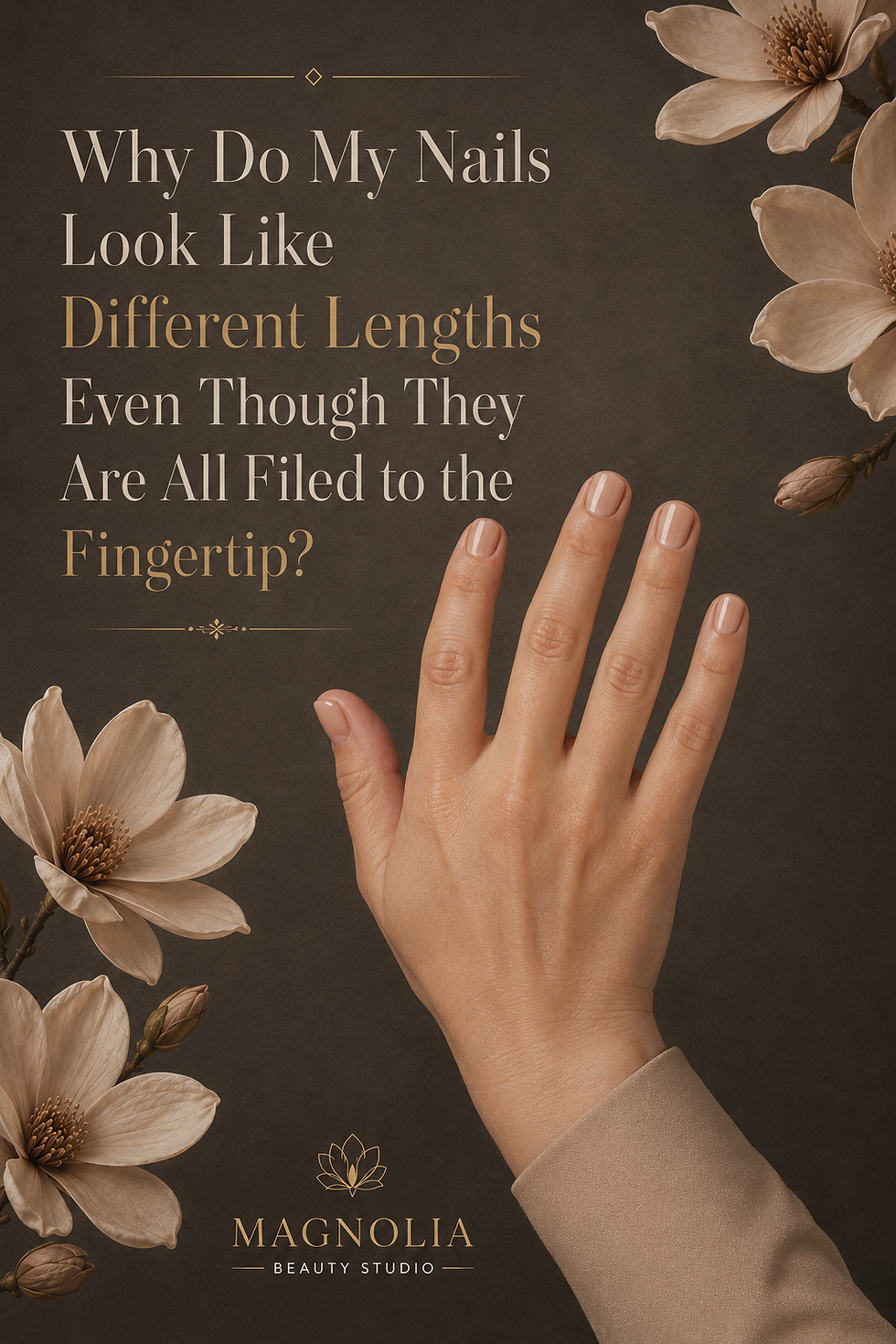
Why Do My Nails Look Like Different Lengths Even Though They Are All Filed to the Fingertip?
This is something that surprises many clients, especially when they need or prefer very short nails.
You may look at your finished manicure and think:
“Why does one nail look longer than the others?”
In many cases, the answer is connected to the natural anatomy of your nails rather than incorrect filing.
Every Nail Bed Is Different
One of the most common misconceptions is that every fingernail is naturally the same length, width and shape.
In reality, every finger can have a differently sized nail bed — the pink part of the natural nail attached to the skin underneath.
For example:
-
the index fingers may have shorter nail beds,
-
the ring fingers may have naturally longer nail beds,
-
the thumbnails may be wider,
-
and the little fingernails are usually much smaller.
The nail beds may also begin and end at slightly different points on each finger.
This is completely normal and unique to every person.
What Happens When You Choose Nails Filed to the Fingertip?
Some clients need every nail to be kept exactly at fingertip length. This may be due to work, sport, playing an instrument, caring responsibilities, comfort or personal preference.
In this case, the nail technician will shorten each nail so that none of them extends beyond the fingertip.
However, because every nail bed has a different natural length and shape, the finished nails may not all appear visually identical.
A nail with a longer nail bed may look longer, while a nail with a shorter nail bed may appear smaller — even though both nails end at the fingertip.
This is not necessarily a filing mistake. It is a visual difference created by the natural anatomy of the nails.
Why Can’t They Always Be Made to Look Identical?
To make every nail appear exactly the same length, the nail technician might need to leave some nails extending beyond the fingertip.
For clients who need every nail kept very short, this may not be possible or practical.
The priority is therefore to respect the requested maximum length while creating the most balanced shape possible.
The nails may still look slightly different when compared individually, but each one has been shaped according to the same practical limit: the fingertip.
Beauty Is Not About Perfect Symmetry
Natural hands are not perfectly symmetrical.
No two fingers are exactly alike, and neither are their nail beds.
A professional manicure works with your natural anatomy — not against it.
The goal is not to force every nail to look identical when examined separately. The goal is to create a manicure that looks balanced, neat and harmonious as a whole while still respecting the length that is comfortable and practical for you.
Sometimes, what appears slightly different at first glance is actually the most technically correct result.
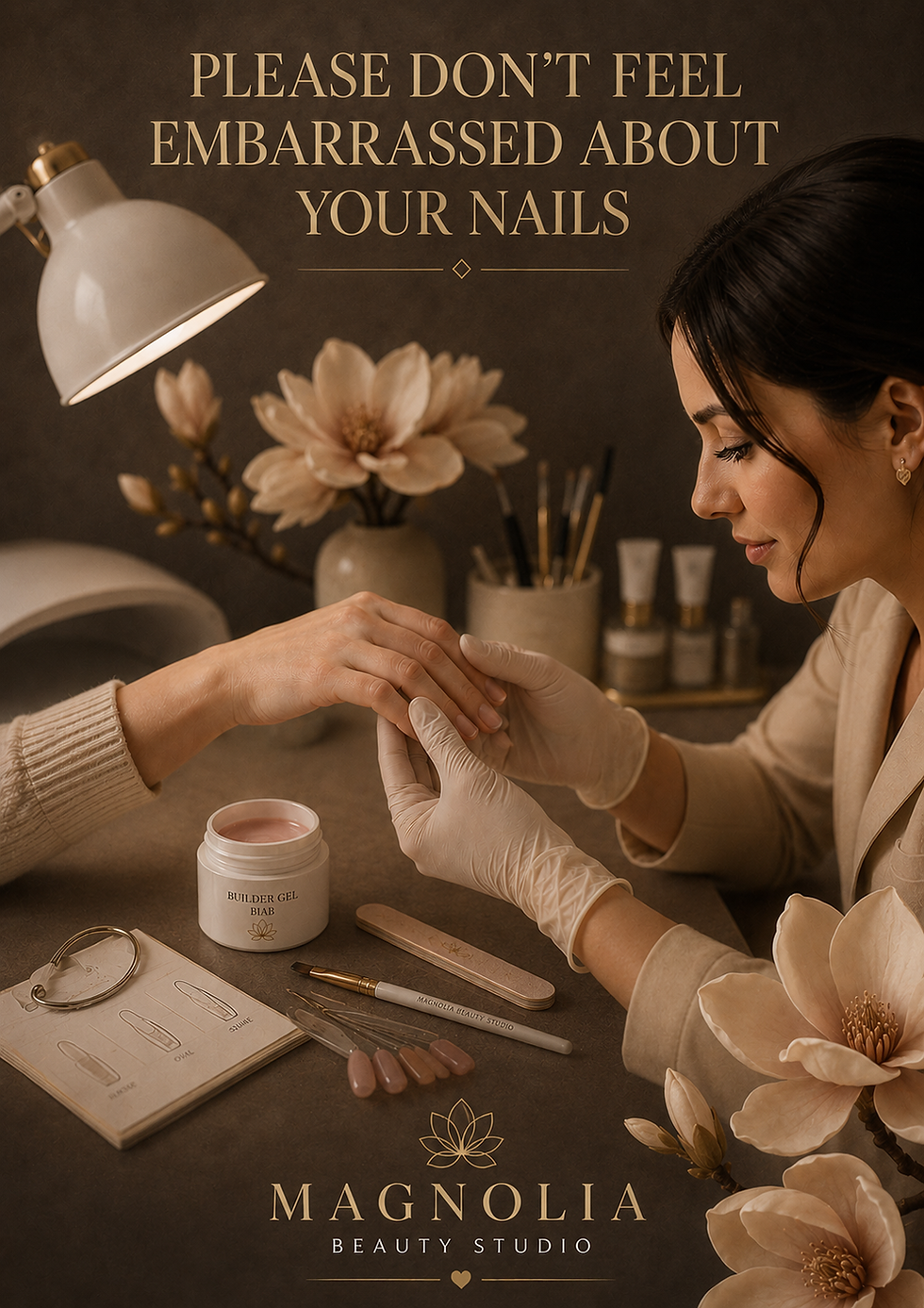
Please Don't Feel Embarrassed About Your Nails
One of the most common things I hear as a nail technician is:
"I'm so sorry about my nails."
"They're in such a terrible state."
"Please don't judge them."
The truth is...
I don't.
As a nail technician, I don't look at your nails the same way you do.
I'm not thinking whether they're pretty, ugly, too short, too long or uneven. My mind immediately switches into "problem-solving mode."
Instead, I'm asking myself questions like:
-
What products will work best for these nails?
-
Do the nails naturally grow straight, upwards or downwards?
-
Where should I build the apex for the strongest structure?
-
Will this client benefit from extra reinforcement?
-
Which shape will suit both their nails and their lifestyle?
Every set of nails is different, and that's what makes my job interesting.
Choosing the Right Nail Shape
Sometimes I may recommend a particular nail shape—not because another shape looks "wrong," but because it may be more practical for your everyday life.
If it's your first appointment and your nails are suitable for several different shapes, I may ask what kind of work you do.
For example, people who spend long hours typing on a keyboard often experience more chipping or corner breakage with square-shaped nails because the corners repeatedly hit the keys.
Your lifestyle, daily activities and natural nail shape all help me recommend the option that is most comfortable, durable and suitable for you.
Why Does My Nail Technician Look Under My Nails?
If you arrive with long natural nails and ask for them to be shortened significantly, you may notice your nail technician looking underneath your nails before filing.
This isn't to check whether your nails are clean.
Your nail technician is checking the position of the hyponychium—the sensitive skin attached to the underside of the nail.
Sometimes, especially with long natural nails, the hyponychium grows further forward than expected. If this isn't checked first, shortening the nails too much could cause pain or even injury.
By checking underneath the nail, your nail technician can determine how much length can be safely removed while keeping your nails comfortable and healthy.
There Is No Judgement Here
Whether your nails are bitten, damaged, naturally weak, growing in different directions or simply overdue for an appointment, your nail technician has almost certainly seen it before.
My job isn't to judge your nails.
My job is to understand them, work with them and help you achieve the healthiest, strongest and most beautiful result possible.
So the next time you sit down for your appointment, there's no need to apologise.
Just relax—I'm already thinking about how to make your nails look their absolute best.
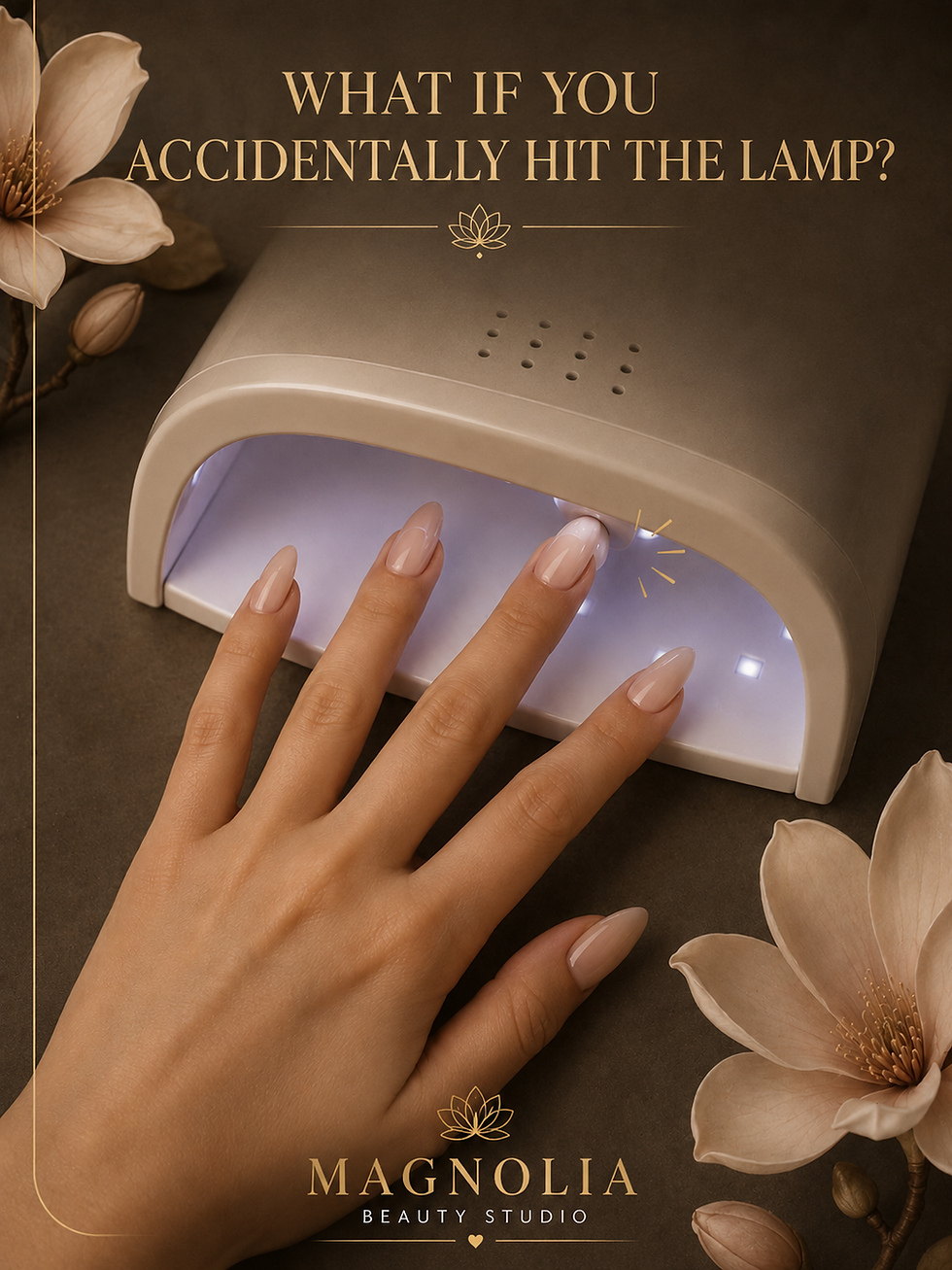
What If You Accidentally Hit the Lamp?
Accidents happen.
Sometimes, while placing your hand into the lamp, a finger may accidentally touch the side or top of the lamp before the product has cured.
If this happens...
Please tell your nail technician immediately.
There's absolutely no need to feel embarrassed.
Why Is It Important to Say Something Straight Away?
Before the product has cured, it's still soft and easy to adjust.
In many cases, your nail technician can simply smooth the product, correct the shape and continue with the treatment in just a few moments.
What Happens If You Don't Say Anything?
Sometimes clients worry they'll interrupt the appointment or feel embarrassed, so they stay quiet.
Unfortunately, once the product has cured, any dent, fingerprint or accidental movement becomes locked into the nail.
Correcting it may then require additional filing, reshaping or, in some cases, removing and rebuilding part of the nail.
What could have taken just a few seconds to fix may end up taking much longer.
There's No Need to Apologise
Every nail technician has experienced this many times before.
Hands move.
People accidentally bump the lamp.
It happens.
The most helpful thing you can do is simply let your nail technician know as soon as it happens.
Remember...
It's always much easier to fix uncured product than cured product.
A quick "Oops, I touched the lamp!" is all your nail technician needs to hear.